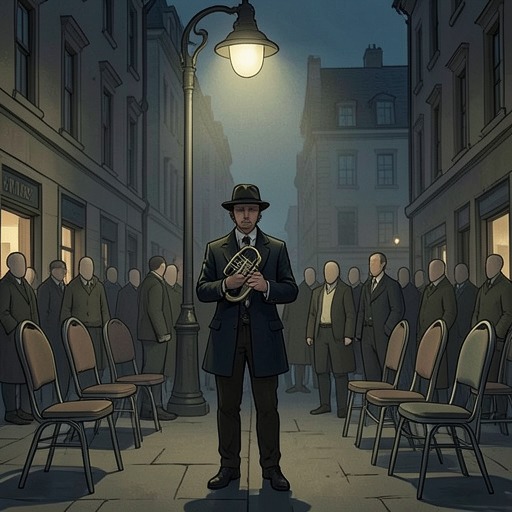
Anarchist miracle
The Crying of Lot 49Anarchist miracle is Jesús Arrabal’s name for the sudden intrusion of a different social order into ordinary life: a leaderless revolution in which people reach consensus as effortlessly as a body coordinates its parts. The phrase joins political hope to an unsettling problem of recognition. When people act in perfect accord, the result may look like collective freedom, but it may also expose how little an observer can know about the system—or the world—governing them.
Arrabal’s Political Ideal
Arrabal distinguishes his miracle from the kind of miracle described by Bakunin. He imagines another world touching this one, usually without disturbance but, at the point of contact, with cataclysmic force. Anarchists, he says, share with the church a belief in another world: one in which revolutions erupt spontaneously, without leaders, and the masses’ capacity for consensus lets them work together without conscious effort. The ideal is not merely the overthrow of authority; it is coordination so natural that collective action resembles the functioning of a body.
Yet Arrabal refuses to treat the ideal as an ordinary political outcome. If such a revolution ever happened with perfect spontaneity, he says, he too would have to call it a miracle. The word marks a boundary between a hoped-for form of social life and anything that can be explained as routine political organization. Anarchist miracle is thus both a vision of possibility and a measure of how extraordinary its realization would seem.
Pierce as an Impossible Example
Arrabal applies the same term to Pierce Inverarity, whom he encounters on a beach after an antigovernment rally he had announced attracted no one. True to his faith, Arrabal has sought out Pierce, an enemy, in order to learn from him. Pierce meets him with such perfectly neutral manners that he appears to embody, without remainder, the privileged gringo whom anarchists oppose. Arrabal is disturbed enough to ask Oedipa whether Pierce is real, a spy, or making fun of him; she does not understand what he sees.
The problem is not simply that Pierce is wealthy or obnoxious. Arrabal finds him too exactly and flawlessly the thing the movement fights. In Mexico, Arrabal observes, the privileged person is ordinarily redeemed to some degree by being one of the people; Pierce offers no such reconciliation unless he is joking. His likeness to the enemy is so complete that Arrabal compares it to the terrifying appearance of the Virgin to an Indigenous person. The comparison makes Pierce less a political opponent than an inexplicable sign: an apparent realization of the very opposition that should be impossible to encounter so perfectly.
Oedipa remembers the meeting years later because Arrabal had perceived something about Pierce that she had not. She recalls him as a kind of nonsexual competitor, and wonders whether, without the reassurance of this apparent miracle, he might have abandoned the CIA and joined the majority party, avoiding exile. The recollection gives Pierce’s anomaly a consequence beyond the beach: it may have shaped Arrabal’s path, while also linking the two men in Oedipa’s later attempt to interpret coincidences.
The Silent Dance
The concept returns not as a political speech but as an event Oedipa witnesses among deaf-mute delegates at a hotel. After following a W.A.S.T.E. letter carrier across Oakland and Berkeley, she returns exhausted to a lobby filled with drunken delegates in party hats. They sweep her into a ballroom, where a young man leads her into a dance beneath an unlit chandelier. Couples move to different rhythms—tango, two-step, bossa nova, and slop—without any audible common music.
Oedipa expects the independent movements to collide. Instead, for half an hour, the dancers move without touching anyone except their own partners, then stop together by what seems to be a mysterious consensus. The scene supplies a concrete analogue for Arrabal’s description: diverse participants coordinate without a visible leader or shared audible cue. But Oedipa cannot adopt his interpretation. She leaves demoralized, unable to name what she has seen or to know whether an order beyond her perception explains it. What might look to Arrabal like an anarchist miracle becomes, for her, another instance of an apparent pattern she cannot verify.
Meaning and Uncertainty
The dance sharpens the distinction between a collective order and the observer’s access to it. The delegates’ movements do not prove that they share an extra sense or that an invisible principle directs them; those possibilities belong to Oedipa’s anxious interpretation of what she cannot hear or explain. The event nevertheless makes Arrabal’s political image imaginable: coordination can appear effortless precisely when its basis remains hidden from an outsider.
That uncertainty connects the concept to Oedipa’s wider investigation. She has seen W.A.S.T.E. postmen, a mailbox, stamps, and cancellations, and she wants Dr. Hilarius to tell her the system is fantasy and that there is no Tristero. Yet she also fears what it would mean if the pattern were real. Anarchist miracle offers no resolution between ordinary coincidence and an alternative order. Instead, it names the moment when apparent coordination or an uncanny resemblance makes the boundary between those explanations feel unstable.